
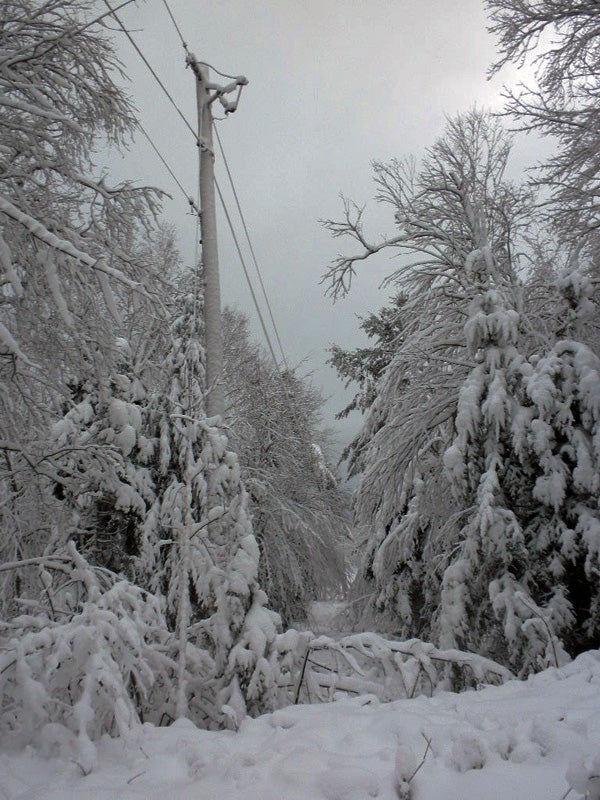
 Storm Preparation is Year-Round Work
For most Mainers, storm preparation doesn’t begin until there is a dire weather forecast, but for Eastern Maine Electric (EMEC, the Co-op), storm preparation is a never-ending process. A lot of time and money are spent storm-hardening the delivery grid to minimize the number of outages before they occur.
A critical aspect of storm-hardening is vegetation management in the power line right of way. EMEC coordinates with logging companies and works with vegetation management contractors to trim, clear, and slow the growth of trees near the power lines. This process is especially important for EMEC, which serves the most rural service territory in the country’s most tree-shaded state.
At the same time, Maine’s beautiful and abundant trees are part of what draws people to the region. The Co-op consults with landowners when the power lines run near cultivated yards, gardens, and farms.
What is power line “right of way?”
For electric utilities, “right of way” refers to a specified width of land under and surrounding the power lines and poles. The path widths vary from thirty feet to 150 feet, depending on the type of overhead line.
Trimming and Clearing
The most labor-intensive right of way maintenance is clearing and trimming, which is performed with the help of bucket trucks, track machines, chippers, chain saws, and excavator tree mowers. The Co-op contracts out much of this work.
Trimming and clearing efforts focus on trees close to or directly beneath the lines. Tall evergreens and hardwoods are cleared, unless they are in cultivated yards, where they are trimmed only as much as necessary to protect the power lines.
In many areas, trees and shrubs are cleared to the ground. Even low growing bushes and cultivated plants are often cleared, because they will limit access by vehicles to the right of way.
Selective Use of Herbicides
In some areas, it is necessary to use herbicides to prevent rapid regrowth of trees. Ultimately, clearing work is intended to last seven to ten years. Hardwood shoots that spring from stumps, however, can grow fast enough to interfere with the lines in five years or less.
Treating the stumps of cleared trees with herbicides will prevent this rapid regrowth, which will increase the time between clearing cycles, thereby lowering expenses.
The Cooperative uses only Maine-licensed contractors, and the herbicides used are approved for these purposes by state and federal regulators.
Objective measures of toxicity indicate that the impact on animals from herbicide spraying is minimal. Sprays used by EMEC contractors have less impact on animals than the gasoline engines of the chain saws and motorized equipment used to do the trimming and clearing. In fact, the herbicides most commonly used have lower toxicity rates to animals than aspirin.
Right of Way Consultation
EMEC is committed to maintaining service quality, while keeping in mind the beauty that makes Eastern Maine so memorable. If you would like to be consulted before trimming is done on your property, please contact:
EMEC
Attn: ROW Consultation
P.O. Box 425
Calais, ME 04619
Tel- (207) 454-7555
Tel- (800) 696-7444
Email- info@emec.com
NOTE: It may not be possible to consult with landowners during emergency clearing and trimming.
Landowner-Maintained Right of Way Agreement
We understand that some members have concerns about herbicide use, and we take those concerns seriously. To balance the needs of our membership at large with the concerns of individual members, the Co-op now offers Landowner-Maintained Right of Way Agreements.
Under these agreements, landowners agree to regularly trim and clear trees in the right of way to the Co-op’s specifications, before such trees reach a certain height. In exchange, the Co-op agrees to forego the use of herbicides in the agreed-upon area. If a member falls behind on right- of-way maintenance, the Co-op is authorized to use its own methods, including the use of herbicides, to bring the right of way back up to standards.
If you would like to discuss a Landowner-Maintained Right-of-Way Agreement, please contact:
Eastern Maine Electric Co-op
Attn: Landowner-Maintained ROW Agreements
P.O. Box 425
Calais, ME 04619
(207) 454-7555